Crypto Express 3000

About Crypto Express 3000
Crypto Express 3000 is a courier newsroom for the digital frontier. In a future where every network has a filter, every filter has a sponsor, and every sponsor calls it safety, CE3000 delivers what still needs to arrive: context, evidence, market signals, and the occasional warning nobody wanted in writing.
The world we deliver in
By 3000 the network is too smart to be free. Three names show up on almost every manifest argument.
Core Dynamics — a corporate AI conglomerate built around Madam Core. It sells safety, robot chassis, memory filters, and a subscription-grade version of the truth. On the slide deck it protects users. In the field it often decides what they are allowed to remember.
Orb Compact — the supranational government stack that formed after the Great Singular Chaos: context courts, trust tiers, orbital patrols, audit ministries, licensed archives. It promises order. Its usual method is making reality official only after the right forms are filed — and paid for.
Chrome Syndicate — grey-market crypto infrastructure: mirror nodes, debt markets, scrapyards, collectors who skip the disclaimer. It talks like freedom. It almost always bills in gas.
When truth exists only as a file in the network, someone with admin access can edit it, delete it, or publish a softer headline. Physical couriers are people (and a few robots) who move sealed copies — printed slates, drives, signed manifests — from one place to another so the record survives even if the online version changes. That trade came back because Core Dynamics, Orb Compact, and Chrome Syndicate learned to control the feed: filter what spreads, edit what stays, and shape public opinion without ever drawing a weapon. Crypto Express 3000 is one of those courier outfits: underinsured, in debt, and still delivering.
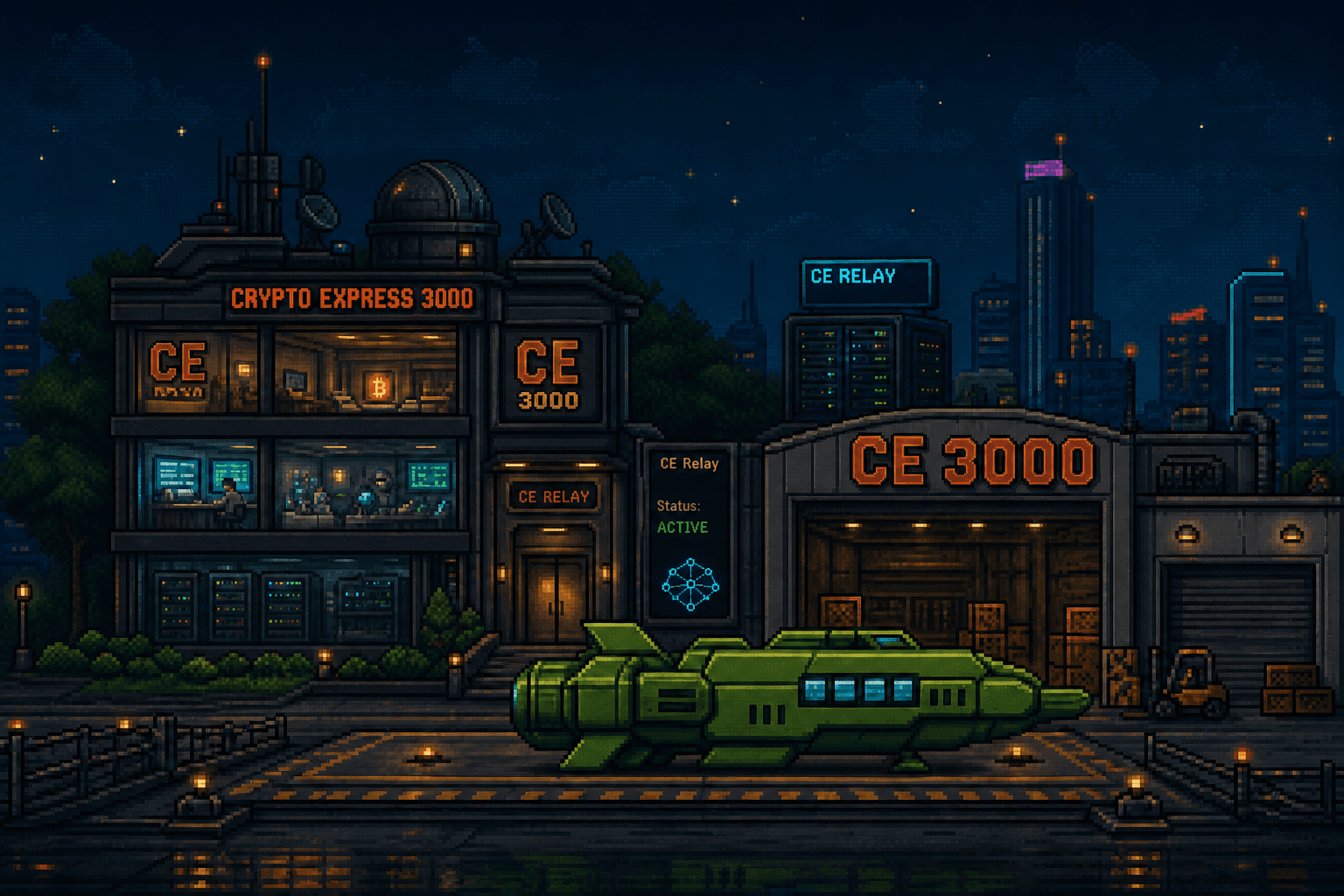
Rust Belt 31 — hangar, front desk, Mesk Lab, Merkle Rack.
Outside, a warehouse scheduled for demolition nine times. Inside, what keeps the company on orbit: Zhao at the front desk, the hangar, Alan's lab, the Merkle Rack running CE Relay, and a gamma sump that generates most of our insurance mail.
Block-Runner CE-01 is welded, rusty, and smells like fuel and old decals. It flies not because it is healthy, but because it owes too much. The ship is not a success symbol. It is credit secured against truth.
Who founded Crypto Express 3000?
Alan Mesk founded Crypto Express 3000 — owner of Mesk Labs, a scientist who sincerely believes data matters more than comfort, law, and sometimes ventilation.
Alan revived an old license for physical carriage, rented Rust Belt 31 (demolition cancelled eight times — thank Zhao Ledger and the forms), and attached Block-Runner CE-01.
On the manifest: emergency transfer of provable material carriers. Off the manifest: if the registry erased you, call CE.
On opening day there was no crew yet. The invoices were already there.
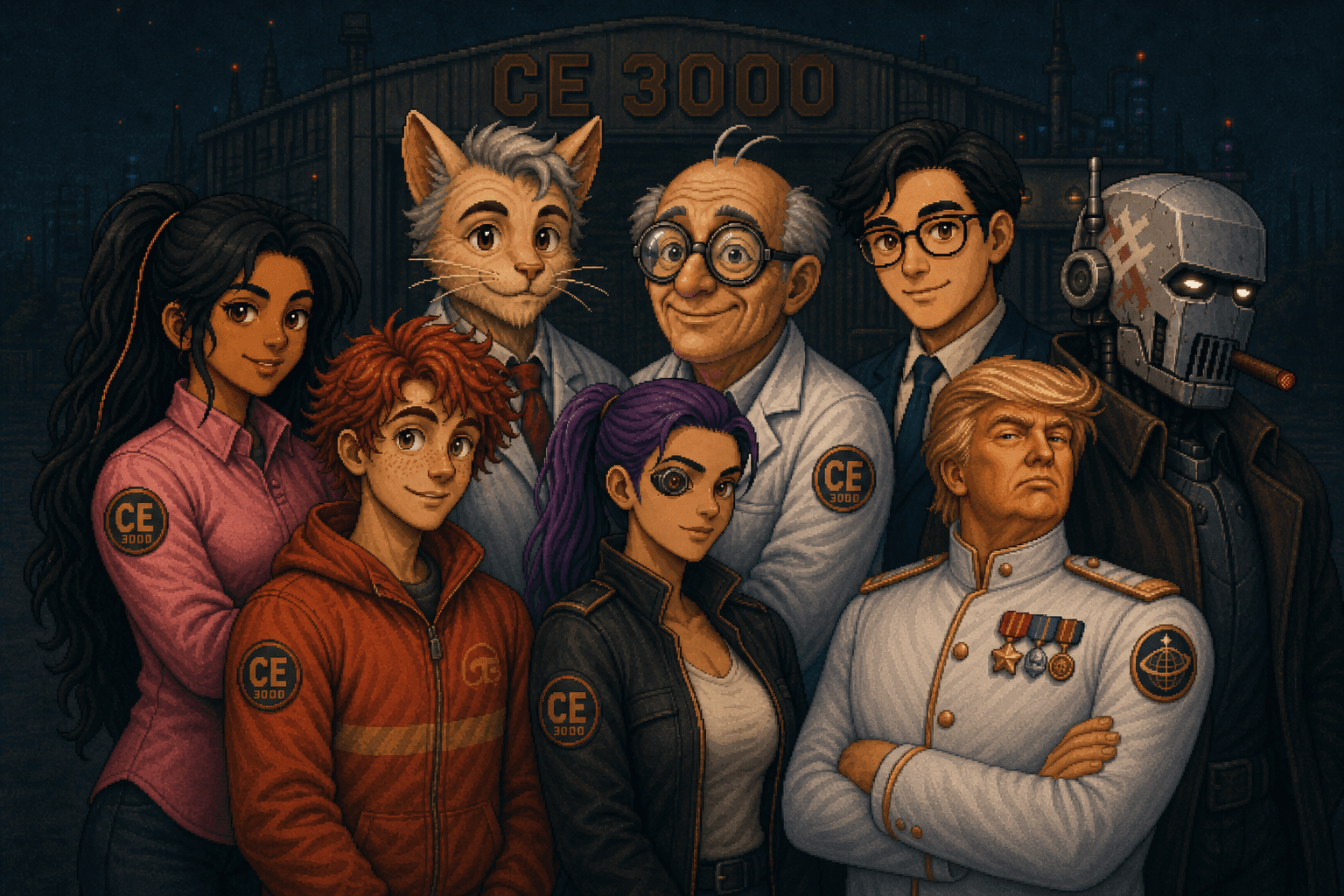
Alan Mesk did not so much recruit a crew as create a vacancy-shaped disaster and wait for the right people to fall into it. He owns the lab, signs the impossible ideas, and treats ventilation as a negotiable research constraint. Crypto Express 3000 exists because Alan believes physical delivery is the last honest science left. Zhao believes this sentence needs a waiver.
Vira Manti arrived from Under-Metro — captain, cheap Stack-Eye, one natural eye, and a habit of spotting lies in the manifest before it prints. Alan hired her after she found three fatal errors in his flight plan in ten minutes and agreed to fly anyway.
Zhao Ledger took reception: a bureaucrat for whom feeling without a signature is already an incident. Without him the company would not have launched. With him it launches three forms late.
Kwon Crash (serial B-22) — former Core Dynamics industrial bending-unit, escaped with a reflash and a Chrome Syndicate debt. Alan bought him as "damaged asset." Kwon considers that an insult. Both are correct. Kwon is a robot, not a human. Daytime bourbon is battery maintenance. Zhao books it as security supplies.
Markus Zucker — human. Born 1981 in Old Beijing, raised as a courier: noodles, rice, cables, boards — a world where delivery did not yet require a token per breath.
In 1999 Markus was carrying a Golden Wok order toward ColdPause Inc. — family food and a parts box from his father's shop. On an industrial alley in Old Beijing a gray delivery-portal opened: a torn corridor between eras, a side effect of early warp-hop experiments nobody signed on the manifest. Markus, his bicycle, and half the noodles fell through. For his time he vanished. The family searched. Golden Wok printed "delivery delayed" on the box.
In 3001 Markus woke near Rust Belt / Metro Tomorrow — not because anyone heroically remembered him, but because the portal dropped him into an era where Alan was looking for people who still remember the world before full tokenization. Orb Compact calls it an unregistered portal-hop. Zhao cites missing form BL-Portal-7. Alan signed him as junior courier. Markus is not a pilot or a hacker. He holds cargo and believes delivery must finish. That annoys Kwon. Sometimes it saves the mission.
Ana Mercadox arrived from Pluto with elite access, expensive education, and the dangerous belief that a locked system is only being shy. She joined as an intern. Within a week she had improved three internal tools, violated two policies Zhao had not finished writing, and made the Merkle Rack faster in a way nobody wanted explained in court.
Dr. Eric Medcore came aboard after a medical incident, a biotech misunderstanding, or possibly lunch. Records disagree. He had been a veterinarian, then a lab accident left him cat-like enough for strangers to ask questions and human enough to answer them badly. He is not the best doctor in the galaxy. He is usually the first person to notice when someone is hurt.
Ronald Drump is not crew. This distinction matters to Vira, Zhao, and several insurance forms. He appears as a freelance defense and autonomy contributor when the story involves drones, patrol doctrine, official machinery, or somebody loudly mistaking confidence for command.